Written by Jamie Starr – 09/12/2025
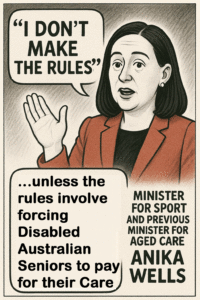
Federal MP Anika Wells’ contrasting positions reveal a striking irony: as Minister for Aged Care she actively introduced user-pays reforms that forced elderly disabled Australians to co-pay for essential home support, yet as Minister for Sport she insists she merely “follows the rules” when it comes to free family travel entitlements. The juxtaposition highlights how she imposed rules on the vulnerable, but benefits from rules when they serve her own interests.
When Anika Wells was Minister for Aged Care, she presided over the rollout of the Support at Home program, a reform that replaced Home Care Packages with a user-pays model. Under this framework, hundreds of thousands of older disabled Australians were suddenly required to make substantial co-contributions for services that had previously been covered. Personal care, meal preparation, domestic help, assisted showers and home maintenance all became out-of-pocket expenses, leaving pensioners and modest retirees struggling to afford the very support that allowed them to live safely at home.
Now, as Minister for Sport, Wells faces scrutiny over her family’s access to free taxpayer-funded travel. Her defence is simple: she claims she does not make the rules, she merely follows them. Yet this defence rings hollow when contrasted with her earlier role, where she did make rules—rules that stripped away affordability for Australia’s most vulnerable seniors.
The Stark Contrast
| Context | Minister for Aged Care (Support at Home) | Minister for Sport (Family Travel) |
|---|---|---|
| Role in Rules | Actively designed and implemented user-pays laws | Claims she only follows existing entitlements |
| Impact on Others | Elderly disabled Australians forced to co-pay for essential care | Family enjoys free taxpayer-funded travel |
| Outcome | Vulnerable citizens cut back on showers, meals, cleaning, risking hospitalisation | Minister’s family benefits from perks without financial burden |
| Public Perception | Seen as betrayal of “ageing in place” promise | Seen as self-serving defence of entitlements |
The Irony
The irony is sharp:
- For herself and her family, Wells embraces rules that deliver personal benefit, insisting she has no power to change them.
- For elderly Australians, she imposed new rules that demanded financial sacrifice, even when those rules undermined health, dignity, and independence.
This duality raises uncomfortable questions about whose interests Wells prioritises. Vulnerable seniors were told to shoulder more costs in the name of “sustainability,” while her own family enjoys taxpayer-funded privileges without scrutiny.
Consequences for Seniors
The Support at Home reforms have already led to:
- Seniors reducing care hours to avoid co-payments.
- Increased risks of falls, infections, malnutrition, and hospital admissions.
- Hospitals reporting “stranded inpatients” who cannot be discharged safely because they cannot afford home support.
These outcomes are not abstract—they are lived realities for hundreds of thousands of Australians who now face the choice between basic dignity and financial survival.
Conclusion
Anika Wells’ defence of free family travel as “just following the rules” is undermined by her record of making rules that disadvantaged the elderly and disabled. The juxtaposition exposes a troubling inconsistency: she benefits from entitlements when convenient, but imposes burdens when others are at stake.
In the end, the question is not whether Wells follows rules, but whose rules she chooses to write—and who pays the price.
Follow-up article to: Betrayal: A Crisis in Home Care
Interested in joining our Seniors Megaphone Call-to-Action email list? Click here.
Click here if you would like to contact the team at Seniors Megaphone.
This article is approved for re-publication
Feel free to share this article online
