Written by: Jamie Starr
Australia’s aged-care sector is in the middle of a profound transformation. The upcoming Support at Home program, scheduled to replace the long-standing Home Care Packages scheme, was intended to create a more sustainable, transparent and efficient system. Instead, the reforms are sparking widespread fears that a new user-pays framework will push thousands of older Australians to the margins of the very system designed to help them remain safe at home.
While policymakers describe Support at Home as “fair”, “modernised” and “sustainable”, front-line workers, families and older Australians themselves say they are already seeing consequences that were never intended. Many report they are preparing to cut back on essential personal care, reduce hours of domestic assistance, or leave the system entirely because they simply cannot afford the increased co-payments that the new model requires.
The promise of “ageing in place” — long regarded as both humane and cost-effective — may soon become harder to deliver.
Too busy to read? Prefer to listen instead? Click here for a podcast on this same article about the Crisis in Home Care
The New Cost Burden Falling on the Elderly
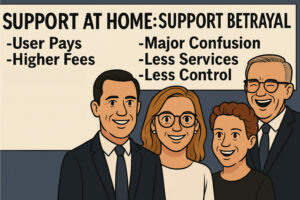
Under Support at Home’s user-pays structure, many services previously included as part of a recipient’s Home Care Package will now attract substantial co-contributions. Personal care, assistance with dressing, meal preparation, domestic help and home maintenance may all involve direct out-of-pocket payments.
For full-pensioners living on fixed incomes, even a modest co-payment represents a significant share of weekly disposable income. For self-funded retirees, the percentage-based contribution model risks imposing unexpectedly high costs for those living modestly but technically above pension thresholds.
The shift is forcing many older Australians to reconsider the support they receive. Instead of accepting necessary levels of care, recipients are beginning to strategise around what they can afford, not what they need.
One 79-year-old widow summarised the dilemma: “I will have to choose between fewer showers, or less cleaning, or less help with meals. I can’t afford everything they’re expecting me to pay for.”
Her experience is far from isolated.
Cutting Care to Cut Costs
Support at Home’s model assumes that recipients will be willing — and able — to contribute towards the cost of their own support. But private feedback from providers suggests the opposite is beginning to happen: older Australians are already signalling that they will reduce the number of hours of care they receive to avoid higher co-contributions.
This trend has severe implications.
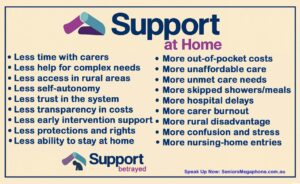
Reducing domestic assistance may seem minor, but for frail individuals, a missed cleaning service can increase falls risk. Declining shower assistance can lead to hygiene issues, skin infections and avoidable hospital admissions. Reducing meal support can accelerate malnutrition.
Every hour removed from a support plan now risks creating greater demand for acute care later.
Providers warn that the reform unintentionally incentivises recipients to accept “minimum-viability care” — the bare minimum they can afford — which may not be adequate for safe living at home. This undercuts the program’s core purpose: preventing premature entry into residential aged care and avoiding unnecessary hospital stays.
Hospitals Already Feeling the Pressure
The introduction of Support at Home has coincided with rising concerns inside hospitals nationwide. Clinicians report that some older patients no longer meet the safety threshold for discharge because they cannot secure adequate in-home support under the new user-pays framework.
Gerontology specialists confirm a growing category of older patients referred to as “stranded inpatients” — individuals medically fit for discharge but unable to return home safely. Previously, home care packages—although imperfect—were able to bridge these gaps. The new cost structure may limit that safety net.
Prolonged hospital stays not only increase health-system expenditure; they reduce the availability of acute beds, delay elective surgeries and place significant pressure on nurses and allied-health teams. In rural hospitals, even a handful of delayed discharges can compromise bed flow for an entire region.
State health officials are quietly concerned that the financial burden being shifted away from the federal system is landing directly on state hospital budgets.
A System That Risks Leaving People Behind
Although Support at Home includes a “no worse off” clause for older people who were approved for Home Care Packages before a certain date, many of the most vulnerable future recipients — those entering the system after the transition — may face the highest costs.
Costs that:
-
discourage access to early support
-
increase deterioration at home
-
burden hospitals
-
precipitate early admission into residential care
This could lead to a two-tier home care landscape:
grandfathered clients who retain manageable fees, and new entrants facing substantial cost barriers.
Social-policy analysts warn that this may unintentionally create inequity based on the timing of a person’s assessment — a variable over which older Australians have little control.
Regional & Low-Income Australians at Higher Risk
Support at Home has been presented as a universal national system, but the impact will not be uniform.
1. Regional Australians
Older people living in rural and regional areas often rely heavily on subsidised care due to limited family support and fewer private service options. With higher travel costs and fewer local providers, even small increases in co-contributions may render services unaffordable.
2. Low-Income Australians
For people living solely on the Age Pension, mandatory co-payments may consume a significant portion of weekly income. Many already struggle with rising rent, electricity and food costs. The introduction of a user-pays framework may push them to decline essential services.
3. Older People with Multiple Conditions
Chronic illness increases support needs. Under the new model, these individuals face not only higher support requirements but also higher personal costs — compounding vulnerability.
Providers Under Strain
Behind the scenes, providers are facing their own pressures. Many organisations report:
-
higher administrative complexity
-
uncertainty in fee-setting
-
difficulty explaining changes to clients
-
increased emotional support needs as clients express fear or anger
-
growing concerns about unpaid invoices
-
rapid changes in demand patterns as clients reduce hours
Some are quietly preparing for significant revenue shortfalls if large numbers of recipients reduce services to avoid co-payments.
Others worry that the reforms may push smaller community-based providers to the brink of closure — leaving older Australians with fewer options and longer wait times.
The Policy Gap: Aged at Home vs. Aged in Hospital
Australia’s aged-care philosophy has long centred on enabling older people to remain at home for as long as possible. But the Support at Home program risks shifting cost burdens in ways that make this goal harder to achieve.
If older people reduce care due to financial stress:
-
falls increase
-
infections increase
-
malnutrition increases
-
carer burnout increases
-
hospital admissions increase
-
hospital length-of-stay increases
-
residential aged-care entry occurs earlier
Every one of these outcomes is significantly more expensive than providing adequate home support.
The question emerging from clinicians, policy analysts and providers is simple:
Is cost-shifting creating a false economy?
The Future Consequences
Unless the Support at Home funding model is amended or calibrated carefully, the nation risks an escalating cycle of disadvantage.
In the short term:
-
Older Australians will reduce services to cut costs
-
Providers will see unpredictable service demand
-
Hospitals will experience more delayed discharges
-
Families and informal carers will take on additional stress
In the medium term:
-
Demand for residential aged-care beds will rise
-
Frailty will increase across the in-home population
-
Health-system costs may exceed projected savings
In the long term:
-
Australia could face a generational divide in access to home care
-
The principle of “ageing in place” may erode
-
The cost-burden shift may ultimately fail to reduce national expenditure
Support at Home was conceived to fix long-standing issues in the aged-care system. But without urgent adjustment — particularly around co-contributions, affordability safeguards and realistic modeling of recipient behaviour — the reforms risk producing outcomes contrary to their intent.
The crisis in home care is no longer theoretical. It is unfolding now. And if the pattern continues, Australia may soon face a reality in which thousands of older Australians cannot afford to remain safe in their own homes — and the entire health system will bear the cost.
Interested in joining our Seniors Megaphone Call-to-Action email list? Click here.
Click here if you would like to contact the team at Seniors Megaphone.
This article is approved for re-publication
